Learning Outcomes:
i. Students will grasp the concept of Newton's law of universal gravitation, recognizing its role in describing the force of gravity between objects.
ii. Apply Newton's law to calculate the mass of Earth, understanding the relationship between Earth's mass, the gravitational constant, and the radius of Earth.
iii. Appreciate the significance of this calculation in determining the masses of other large celestial bodies, such as planets and stars.
iv. Recognize the limitations and assumptions involved in this calculation, understanding the approximations involved in treating Earth as a perfect sphere and using average values for Earth's radius and gravitational constant.
v. Demonstrate an ability to solve simple problems involving Newton's law of gravitation, including calculating the force of gravity between objects and determining the mass of celestial bodies.
Introduction:
As we observe the objects around us falling towards Earth's surface or witness the gravitational pull of planets and stars, we witness the pervasive influence of gravity, the force that governs the motion of celestial bodies. Newton's law of universal gravitation, a fundamental law in physics, provides a mathematical framework for understanding this force and its implications. This lesson delves into the realm of gravitation, focusing on calculating Earth's mass using Newton's law.
i. Newton's Law of Universal Gravitation: A Force that Binds
Newton's law of universal gravitation states that every particle in the universe attracts every other particle with a force that is directly proportional to the product of their masses and inversely proportional to the square of the distance between their centers. This law, expressed mathematically as:
F = G * (m1 * m2) / r^2
where F is the force of gravity, G is the gravitational constant, m1 and m2 are the masses of the particles, and r is the distance between their centers.
ii. Calculating Earth's Mass: A Celestial Weighing Scale
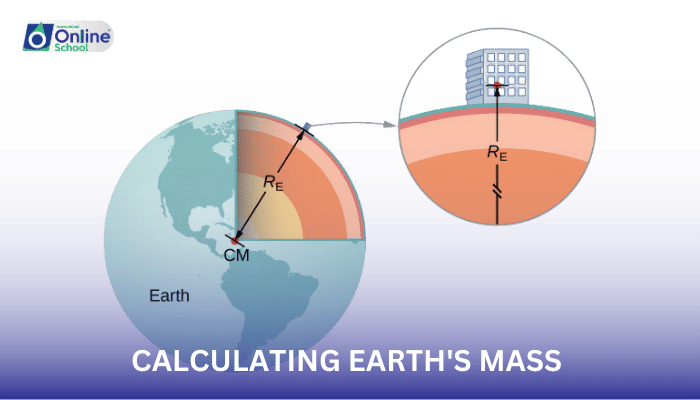
Newton's law of gravitation provides a means to calculate the mass of Earth, a task that would otherwise be impossible due to its immense size. By measuring the acceleration due to gravity (g) at Earth's surface and knowing Earth's radius (R), we can apply Newton's law to determine Earth's mass:
M = g * R^2 / G
where M is Earth's mass.
iii. Significance and Limitations
Calculating Earth's mass using Newton's law has significant implications in understanding the structure and composition of our planet and other celestial bodies. It allows us to estimate the masses of planets, stars, and galaxies, providing insights into their formation and evolution.
However, it is important to recognize the limitations and assumptions involved in this calculation. Treating Earth as a perfect sphere introduces an approximation, and using average values for Earth's radius and the gravitational constant also contributes to the uncertainty.
Newton's law of universal gravitation, a fundamental principle in physics, provides a powerful tool for understanding the force of gravity and its influence on celestial bodies. By applying this law to calculate Earth's mass, we gain a deeper appreciation for the gravitational force that shapes our planet and the universe around us. As we explore the diverse applications of Newton's law, we recognize its significance in various fields, including astronomy, astrophysics, and space exploration.
